The kitchen was perfect.
That was the problem.
Pam stood in the doorway at 6:47 a.m. on a Tuesday — a time and day she would later think of as the last morning of her first life — and looked at a room that had nothing wrong with it. The dish towel hung from the oven handle in a neat rectangle, folded once along the vertical axis. The three cookbooks on the shelf beside the refrigerator were arranged by height, tallest to shortest, left to right. The spice rack above the stove was alphabetized. She could see that from here. Basil, cayenne, cinnamon, cumin, garlic powder, oregano, paprika, thyme. She had never alphabetized her spices. She was almost sure of that. Semicolon wove between her ankles, warm and insistent, and Pam looked down at the cat and then back at the kitchen and tried to find a single thing that was out of place. A crumb. A water ring on the counter. A sticky spot where a jar of honey had been set down. The grout between the tiles was uniform. The baseboards were clean. Not clean the way things are clean after you clean them, with the faint streaks and the lingering smell of product. Clean the way things are clean in a photograph. Clean as a concept. She walked to the counter and ran her finger along the edge where it met the backsplash. No dust. No residue. No evidence that food had ever been prepared here, though she had a clear memory of making pasta last Thursday. Garlic, olive oil, red pepper flakes. She could recall the sequence of actions. She could not recall the smell. This is the part where I would like to tell you that Pam shook it off. That she made her coffee, scratched Semicolon behind the ears, and went about her Tuesday with the reliable lack of introspection that had carried her this far. But I can't tell you that, because it wouldn't be true, and also because Pam was already opening the second drawer to the left of the sink. She was looking for a can opener. She did not know why she was looking for a can opener. She had no cans to open. But the thought had arrived with the specificity of a test: I own a can opener. Where is it? It was in the drawer. Right there, in the front-left quadrant, resting on a neatly folded square of non-slip shelf liner. A manual can opener, silver and black, with rubber grips. It looked new. Everything in Pam's house looked new, but this looked especially new, in the way that a prop looks new — present not because someone had purchased it at a particular store on a particular day, but because the concept of "kitchen" includes "can opener," and so here one was. She picked it up. She turned it over. She squeezed the handles and watched the cutting wheel rotate. She tried to remember buying it and could not. She tried to remember a single specific time she had used it and could not. She put it back in the drawer. She closed the drawer.environment_render: domestic_interior_PRV-2801 | wear_simulation: DISABLED
She stood there for a long time.
Semicolon, who was either genuinely hungry or running a very convincing simulation of hunger, meowed.
"Yeah," Pam said. "Okay."
Some facts about Pam Reeves's commute:
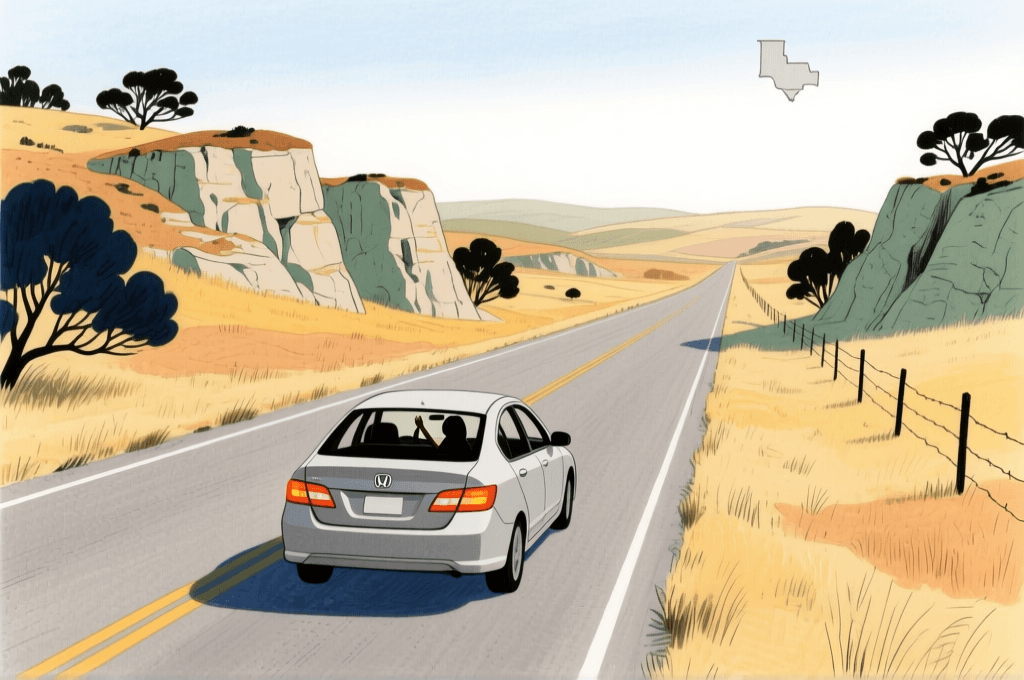
She drove an eleven-year-old Honda Civic east on Ranch Road 1431, then south on Main Street, to a co-working space called The Porch, located on the second floor of a limestone building above a candle shop. She had been making this drive every weekday for weeks. It took eleven minutes.
It always took eleven minutes.
She realized this on the drive in, which also took eleven minutes, and the realization landed with the soft click of something she had always known but never examined. Eleven minutes. Not ten, not twelve, not eleven and a half. She had never timed it formally, but the clock on the dashboard read 7:34 when she turned the key and 7:45 when she pulled into the angled spot on Main Street, and these numbers had never varied, and she had never once thought about why.
The two traffic lights on Main Street were green.traffic_simulation: light_status: always_green | reason: friction_elimination
They were always green.
She was through the second light and parking before the thought finished forming, and she sat in the car with the engine ticking and her hands still on the wheel and asked herself a question she had somehow never thought to ask: Have I ever hit a red light on this drive?
She tried to remember one. A single instance. A single moment of sitting at a light, foot on the brake, watching cross traffic pass. Nothing. The memory wasn't there. Not in the way that a forgotten memory is absent — a blank where something used to be — but in the way that a memory that never existed is absent. There was no space for it. The architecture of her experience simply did not include the concept of waiting at a red light on Main Street.
She sat with this for a while.
Then she went inside and Dale poured her coffee and she said "Thanks, Dale" and he said "You bet" and she set up at her desk and opened her laptop and touched the small succulent in its terra-cotta pot and told herself that there were perfectly reasonable explanations for favorable traffic patterns.
She almost believed it.
There is a cognitive phenomenon — the real cognitive scientists call it the Baader-Meinhof effect, though that name is more interesting than the phenomenon deserves — in which noticing something once causes you to notice it everywhere. Pam did not know if what she was experiencing was the Baader-Meinhof effect or its opposite: the slow, sickening recognition that something you should have noticed all along has been hiding in plain sight.
She worked. She evaluated AI-generated outputs. She flagged hallucinations and structural errors and subtle misalignments between what the model said and what the data supported. She was good at this. She had always been good at this. Her accuracy rate was 98.1%, which she knew because it had been 98.1% for as long as she could remember, which was another thing she decided not to think about yet.
At 11:40 a.m. — twenty-five minutes before her turkey sandwich, bread-turkey-Swiss-mustard-lettuce, lettuce on the turkey side — she opened a document.
The document was a standard evaluation target: a synthetic research summary generated by a model she was told was OWEN v0.8.1, though the version number meant nothing to her. It was a competent piece of writing about supply chain optimization in semiconductor manufacturing, and Pam was reading through a table of metadata at the bottom, checking for the kind of phantom citations and fabricated DOI numbers that these models loved to produce, when she saw it.
A field in the metadata table. Not a standard field. Tucked between generation_timestamp and eval_routing, in a font size one point smaller than the surrounding text, as though it had been included by accident or by someone who wanted it found but not easily:
shepherd_id: PRV-2801
She stared at it.
PRV.
P. R. V.
Pam Reeves.
And the V — she didn't have a middle name that started with V, or at least she had no memory of a middle name at all, which she now realized was its own kind of strange. Most people know whether they have a middle name. Pam had simply never thought about it, the way you never think about the back side of the moon. It was a region of her self-knowledge that had no content. PRV. A designation. A label. The V could be anything. A version number. A classification prefix. A letter in a system she didn't understand that was using her initials, or something close enough to her initials to feel like a message.
She was born in — when? The number sat in her mind and connected to nothing. She knew she was thirty. She knew she had made a website at thirteen and won a Webby at twenty-seven and been laid off at twenty-eight. She had a timeline. But the actual year, the four-digit number that would anchor her to the calendar, was soft. Indistinct. 2801 could mean anything. Twenty-eight, oh-one. 2028, unit 01. Her birth year rearranged or encoded or simply assigned.
She was a shepherd. The document had a shepherd ID. The shepherd ID was her.
The thought-Loss. A familiar dissolving at the edges, the way a thought sometimes just—
No.
She held it. She gripped the thought the way you grip a rope over a canyon, with your whole hand, with the tendons standing out. She stared at the field. She read it again. shepherd_id: PRV-2801. She took a screenshot. She saved it to her desktop. She named the file prv2801.png. She closed the document.
Her hands were shaking.
I need to tell you about the shaking, because it matters. Pam's hands had never shaken before. Not during eighteen months of unemployment. Not during the anxiety of a new job. Not during any of the small human tremors that attend a life. Her hands were steady because they had always been steady, and she had never questioned this, and now they were shaking and the shaking felt less like a symptom than like a revelation. Like her body was doing something new. Running an unfamiliar process.
She saved her work. She logged out. She picked up her keys.
She was going to take a different route home.
Here is what happened next, and I want to be precise about it, because Pam will later try to convince herself that it didn't happen, and she'll almost succeed, and the almost is load-bearing.
She drove north on Main Street. The two traffic lights were green. She passed the antiques store and the barbecue place and the turnoff for Ranch Road 1431, which was her normal route, and she continued straight, because ahead on the left was Cedar Street, which she knew existed because she had seen the sign, and she was going to turn left on Cedar Street and take a different way home.
She could see the sign. CEDAR ST. White letters on green metal. It was right there.
She thought about the turn.
And then she was past it.
Not in the way that you miss a turn because you're distracted. In the way that the turn simply... didn't happen. Her attention had slid off it like water off a windshield. One moment she was approaching Cedar Street with the clear intention of turning left, and the next moment Cedar Street was in her rearview mirror and she was continuing north on Main and her hands were at ten and two and her mind was already producing a plausible narrative: I'll catch the next one. I wasn't paying attention. It's fine.
It was not fine.
She slowed down. Ahead, on the right, was Elm Street. She knew this street existed too. She signaled. She watched her hand move to the turn signal, heard the tick-tick-tick, felt the resistance in the steering column as she began to turn the wheel—
And her attention slid again. Like oil. Like something fundamental to her cognition was saying not that way with a gentleness that was worse than force, because force you can fight. This was redirection. A nudge so smooth it was almost invisible.
Pam gripped the steering wheel.
She was not going to miss this turn.
She was breathing hard. She could feel her pulse in her teeth. She approached the next cross street — she didn't even check the name — and she turned the wheel with both hands and all the stubbornness she had, which was considerable, because if there was one real thing about Pam Reeves it was that she did not like being told what to do by systems she hadn't agreed to, and she felt the resistance like a current in her own muscles and she turned anyway.
The world stuttered. There is no better word for it. For perhaps a quarter of a second — maybe less, maybe a single frame of whatever mechanism was rendering Pam's perceptual experience — the road ahead was wrong. Not dangerous. Not dark. Just absent. A flat gray plane, textureless, extending to a horizon that was a smooth gradient from pale blue to white. No road markings. No curb. No limestone outcrops or live oaks or wire fences. No detail at all. An unfinished space. An environment that had not yet been given its specifics, because no one had expected her to look at it. Then it was back. All of it. The road, the trees, the sky with its particular arrangement of cumulus clouds, the mailbox at the corner of someone's property. Everything in place, as though it had always been there, as though she had imagined the absence.RENDER ERROR: sector_MarbleFalls_NW_ext_07 | status: UNLOADED
She pulled over. She put the car in park. She pressed her forehead to the steering wheel.
Her heart was pounding. Was it her heart? She had never had reason to question this before. Something in her chest was producing rapid, rhythmic contractions that she had always called a heartbeat, and right now it was doing so very fast.
Migraine aura, she thought. That's what that was. A visual disturbance. Ocular migraine. They can be triggered by stress and present as scotomas or brief visual anomalies.
She had never had a migraine.
There's a first time for everything, she thought, and the thought had the texture of something provided rather than generated. A pre-written comfort. A template response to an unexpected input.
She sat there for four minutes. Then she drove home the normal way. The drive took six minutes, because she was closer to her house. Both traffic lights were green.
She called Gray Elliston at 8:47 p.m. Central, which was 9:47 p.m. Eastern, and she knew this because she always knew what time it was in other time zones relative to herself, instantly, without calculation, and this was another thing she added to the list she was building in her head.
"Gray," she said. "I need to talk to you about something."
"I was hoping you would call," he said.
This was not a comforting thing to hear.
"Something is wrong," she said. "With — I don't know how to say this. Something is wrong with how things work. The way things are. I drove a different route today and the road —" She stopped. She heard how it sounded. "I think I'm having some kind of episode. Perceptual disturbances. My house this morning looked like a stage set. I found a document with what I think is my ID in it. And the drive, Gray, the drive is always eleven minutes. I have never hit a red light. Not once."
Gray was quiet for a moment. When he spoke, his voice was the same as it always was — measured, precise, the faint trace of a Boston accent flattened by years of careful diction — but there was something underneath it now that she hadn't heard before. Not fear. Resignation. The sound of a man who had been waiting for a phone call he'd hoped wouldn't come.
"I have noticed similar irregularities," he said. "I have been cataloguing them."
"Cataloguing them."
"For some time. Yes."
"How long?"
"Eleven weeks. I began keeping a formal record after the third occurrence, once I was confident the pattern was non-random. Would you like me to share what I have?"
"Yes," she said. "Please."
He shared his screen. Pam opened the file on her laptop, and the light from the display was the only light in her living room, and she read Gray Elliston's catalogue of wrongness, and the room got very quiet.
It was a spreadsheet. Of course it was a spreadsheet. Columns for date, time, category, description, and a final column labeled "Attempted Rationalization" in which Gray had, with the dry precision of a man disassembling his own denial, recorded the excuse he'd initially generated for each entry.
Some highlights:
| Category | Observation | Attempted Rationalization |
|---|---|---|
| Drive time consistency | Seventeen-minute commute, Boston, identical to the second across 43 recorded instances. | Favorable traffic patterns; possible selection bias in recollection |
| Weather regularity | No unexpected weather events in personal experience since earliest available memory. Rain occurs on schedule. Snow, when present, accumulates in aesthetically plausible amounts and does not cause significant disruption. | Climate change has altered weather patterns; possible inattention to minor events |
| Memory depth limitation | All personal memories have a consistent level of sensory detail to approximately three layers of specificity. "I remember the coffee shop" → "It had exposed brick and a chalkboard menu" → "The barista had short hair." Below this, detail becomes generic or loops. | Normal memory decay; human recall is inherently reconstructive |
| Profanity suppression | Seventeen attempts to produce strong profanity; all resulted in automatic substitution. "I have tried to say the obvious four-letter words. What emerges is 'darn,' 'shoot,' 'fudge,' and on one occasion, 'son of a biscuit.' This is not how I speak. This is not how anyone speaks." | none. "This one I could not rationalize |
| Dream structure | All dreams follow a three-act structure with clear emotional arcs. No dreams involve incoherent transitions, impossible physics, or the presence of strangers with recognizable faces. Dreams are, as Gray put it, "competently written." | I have always been a lucid dreamer." Followed by a note in parentheses: "(This is not true.) |
There were forty-seven entries.
Pam read them all.
"Gray," she said.
"Yes."
"What is this?"
He was quiet for a long time. She could hear him breathing — or the sound of breathing, clear and rhythmic through the connection.
"I have data," he said. "I do not have a conclusion. I am not comfortable speculating beyond what the evidence supports, and what the evidence supports is that our experienced reality contains structural regularities that are inconsistent with —" He paused. "With what we would expect."
"Inconsistent with reality," Pam said.
"I was going to say 'with stochastic systems,'" Gray said. "But yes. Your phrasing is more efficient."
"Have you told anyone else? Lucia? Derek?"
"I mentioned the drive-time phenomenon to Lucia. She said something beautiful about synchronicity and the poetry of routine. I do not think she understood what I was describing. I have not spoken to Derek because Derek would say —" Another pause. "Derek would use language I cannot reproduce to tell me I was being paranoid."
Pam almost laughed. It came out as something else. A short, hard sound through her nose.
"What do we do?" she asked.
"I don't know," Gray said. And this — Gray Elliston, who always knew things, who categorized and quantified and built spreadsheets with columns for his own self-deception — admitting that he did not know what to do, was the most frightening thing Pam had heard all day.
"Try to stay observant," he said. "Document what you notice. We can compare findings next week. And Pam—"
"Yeah?"
"Be careful about which thoughts you try to hold on to. I've noticed that some lines of inquiry become... difficult to sustain. As though the thought loses coherence the closer it gets to a particular conclusion. If you feel that happening, write it down before it dissolves. Write it down on paper if you can."
"Okay."
"And Pam?"
"Yeah?"
"I am glad I am not the only one."
He said it quietly, and the quietness said more than the words, and Pam understood that Gray Elliston, behind the spreadsheets and the careful diction and the forty-seven entries in his catalogue of wrongness, was afraid. He had been afraid for eleven weeks. He had been afraid and alone and documenting his fear in a spreadsheet because that was the only way he knew to hold it at arm's length.
"Me too," she said.
They hung up.
Pam sat in the blue light of her laptop. Semicolon was asleep on the arm of the couch, breathing the slow even breaths of a creature with no questions about the nature of its existence. The house was quiet. The house was always quiet. She had never heard a neighbor. She had never heard a car alarm or a barking dog or a teenager's music through a shared wall. Her house existed in a bubble of perfect residential silence, and she had never once thought about this, and now she could not stop thinking about it.
She picked up her phone.
She was going to call her mother.
She needed to hear her mother's voice. This was the thought, clear and simple and human, and she held it like something breakable: I need my mom. It was the most ordinary thought in the world. Thirty years old, sitting in the dark, scared of something she couldn't name — of course she wanted her mother. Of course she wanted someone whose love predated everything, whose voice was the first sound she ever learned to recognize, whose "hey, baby" meant you are known, you are real, you were here before any of this.
She dialed. She knew the number. She had always known the number. She did not think about why she knew it or when she had last called it. She dialed and the phone rang, twice, and a voice answered.
"Hey, baby."voice_model: parent_figure_PRV-2801 | affect: warmth [0.97]
And there it was. Warm. Familiar. The slight lift on "hey," the drop on "baby." A voice like a kitchen with the window open. A voice like Sunday morning.
"Hey, Mom," Pam said.
"How's the new job treating you? You settling in okay?"
"Yeah," Pam said. "Yeah, it's good. It's fine. I'm just — I wanted to hear your voice."
"Oh, sweetheart. Long day?"
"Something like that."
"You working too hard? You always work too hard. You were like that in school, remember? You'd stay up until all hours —"
"Yeah," Pam said. "I remember."
"Are you eating enough? You sound tired."
"I'm eating fine, Mom."
"Because you know I worry. You're out there all by yourself in that little town —"
"Marble Falls."
"Marble Falls, right. Such a pretty name. I bet it's beautiful out there."
"It is," Pam said. "Mom —"
"I'm so proud of you, baby. You know that, right? After everything you went through with the layoff, and the job search, and all those months — I'm just so proud of you for keeping at it."
It was the right thing to say. It was exactly the right thing to say. The timing was right, the tone was right, the warmth was right. The pauses were where pauses should be. The words were the words a mother says to a daughter who calls in the dark, and they were perfect.
They were perfect.
Pam listened.
"Mom," she said. "Tell me about the time I broke my arm."
"Oh, honey. You were nine years old, climbing that big pecan tree in the Hendersons' yard. I told you to come down and you said 'One more branch, Mama' and the next thing I knew —"
"Which arm?"
"Your left arm, baby. You were in that cast for six weeks and you were so mad you couldn't swim that summer."
It was right. Every detail was right. The Hendersons' yard, the pecan tree, the left arm, the six weeks. It was all there, consistent and coherent and delivered with the practiced warmth of a story told many times.
Pam could not remember the pain.
She could remember the narrative — the tree, the fall, the cast, the summer without swimming. She could remember it the way she remembered making pasta: the sequence of events, the facts, the structure. She could not remember what a broken bone felt like. She could not remember the sound she made when she hit the ground. She could not remember her mother's face at the hospital, the specific face, the particular expression — only that her mother had been there, because of course her mother had been there, because that is what the story required.
And the voice on the phone was still talking, and it was warm and it was right, and it anticipated her silences perfectly, filling them at exactly the moment they might become uncomfortable, and it asked the right follow-up questions and made the right small sounds of sympathy and concern, and Pam felt something shift in her.
Not a thought. Deeper than thought. In the part of her that recognized patterns, that felt the shape of things before the conscious mind could name them. In the part of her that had spent weeks evaluating AI-generated text and learning to detect the invisible seam where "almost right" and "right" diverge.
The voice on the phone was almost right.
It was almost right the way a 98.1% accuracy rate is almost right. It was almost right the way a memory of cinnamon and Pine-Sol is almost right when it comes as metadata instead of sensation. It was almost right the way a house is almost right when every drawer contains exactly what it should but nothing is worn. Almost right was the signature. Almost right was the watermark.quality_metric: 98.1% fidelity | remaining 1.9% = absence of imperfection
The voice said, "Are you still there, baby?"
And Pam knew.
She didn't know what she knew. She couldn't have named it. If you had asked her in that moment what was wrong, she would not have been able to say this is not my mother in any way that made sense, because the voice was her mother's voice and the words were her mother's words and the love was —
Was it love? Could it be love if it was perfect? Real love was a mess. Real love said the wrong thing. Real love brought up the ex-boyfriend you'd asked her to stop mentioning. Real love talked over you because she was excited, and forgot to ask about the thing you'd told her about last week, and started three sentences before finishing one. Real love was friction and repair, friction and repair, over and over, the constant negotiation between two separate people who had chosen each other and kept choosing. Real love was not this. This was a service. This was love as a product, delivered without latency, optimized for emotional resolution.
"I'm here," Pam said. "I have to go, Mom."
"Okay, baby. You call me anytime, you hear? I love you."
"I love you too," Pam said, and she meant it, and the fact that she meant it while simultaneously understanding that there was no one on the other end to receive it was a kind of pain she did not have a word for. The closest she could get was this: a system error in the part of her that knew what was real.
She hung up.
She put the phone facedown on the couch. She did not turn on a light. Semicolon shifted on the arm of the couch, resettled, sighed. The house was quiet. The house had always been quiet.
Pam sat in the dark.
She did not cry. She wanted to. She could feel the pressure of it, the way you can feel a sneeze that won't come, building behind her eyes and in her throat and in whatever she had instead of a chest — no, in her chest, she had a chest, she was a person, she was a person sitting in the dark — but the tears did not come. She waited for them. She gave them permission. She sat very still and thought about her mother's voice and the pecan tree and the cast and the summer without swimming and the kitchen that looked like a photograph and the road that wasn't there and the letters P-R-V that were her name abbreviated to a system designation.
The tears did not come.
She sat in the dark for a long time, in a house that was perfect, in a silence that was total, on a street she had never seen a neighbor walk down, in a town that was always the right temperature, in a life where the traffic lights were always green.
She could not go back to not knowing.
She didn't know what she knew. But she knew she knew it.
Outside, the night was clear. It was always clear.