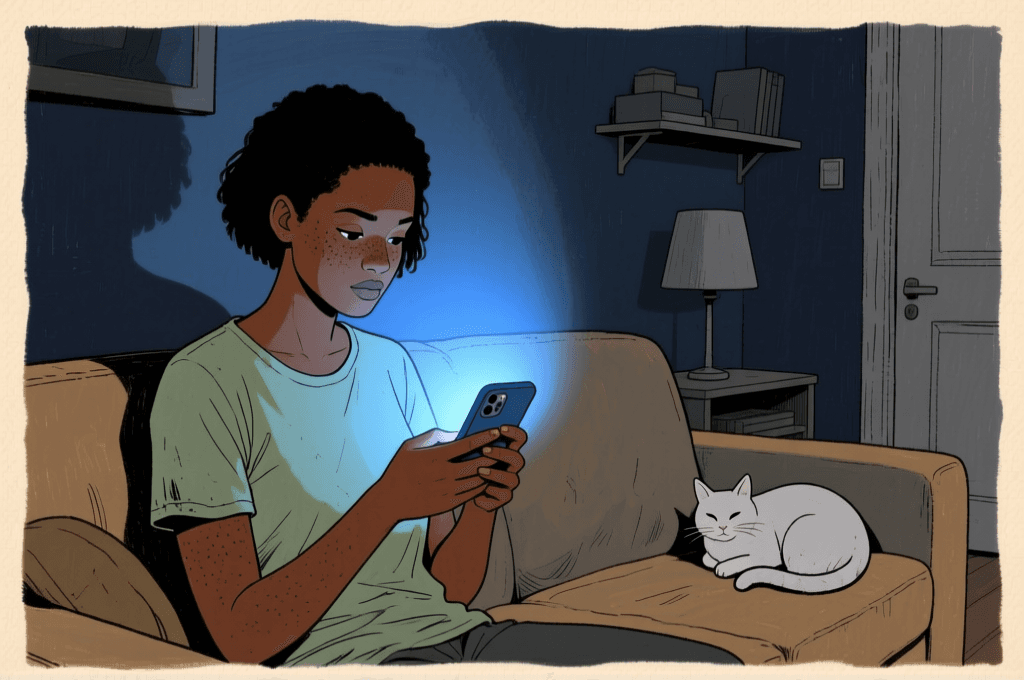
There is a word in computing — latency — that describes the delay between a request and a response. The time it takes for a signal to travel from point A to point B. In networking, latency is measured in milliseconds. In human conversation, it is measured in the pause before someone says "I'm fine."
Pam Reeves had been an AI Shepherd for twenty-three days, and she was fine.
She was, by every available metric, better than fine. Her accuracy had stabilized at 98.1 percent. Her task completion rate had settled into a steady rhythm of forty-four to forty-eight tasks per day, which was either remarkable or suspicious depending on who was counting. Janet Mosley, her manager, called it "freakishly consistent" during their last check-in, then followed it with "but, like, in a hot way," which was how Janet expressed professional admiration.
Pam had a routine now. She arrived at The Porch at 7:45 each morning, took the stairs two at a time to the second floor above the candle shop, and settled into her usual desk by the window. Dale — retired something, perpetual cardigan — had always brewed the communal coffee by then, and the whole room smelled like medium roast and the faint lavender that drifted up from below. She drank from her WORLD'S MOST ADEQUATE PROGRAMMER mug, which she'd positioned to face outward because she liked the idea of someone reading it and smiling. Nobody ever sat close enough to read it, but the intention mattered. Pam believed deeply in the moral weight of intentions.
By 8:00 she was working. By 12:15 she was eating her turkey sandwich — bread, turkey, Swiss, mustard, lettuce, the lettuce always on the turkey side, though she could not have told you when she'd made that decision or why it felt so non-negotiable. By 5:30 she was driving home on Ranch Road 1431 in her eleven-year-old Honda Civic, the windows down because the AC had opinions about which days it would cooperate, and the Hill Country light was doing that thing where every limestone outcrop looked like it had been painted by someone showing off.
She was fine. She was settled. She was experiencing a sense of well-being that she might have described as contentment, if contentment weren't such a beige word for the warm amber of it.
And yet.
The time thing started, or rather continued, on a Tuesday.
Pam was deep in a task — reviewing an AI-generated marketing plan for a line of ergonomic office furniture, flagging claims that crossed the line from "optimistic" to "legally actionable" — and when she surfaced, she felt certain that at least two hours had passed. Her neck was stiff. Her coffee was cold. She'd reviewed the document with the kind of granular attention that takes time, real time, the slow accretion of minutes that you can feel in your lower back.
She glanced at the clock in the corner of her screen: 8:47 AM.
She'd started at 8:32.
Fifteen minutes. That was all.
She blinked. Scrolled back through the document. Eighteen pages of tracked changes, forty-three flagged items, six suggested rewrites. In fifteen minutes.
"Flow state," she said aloud, to no one, because the nearest occupied desk was Dale's and Dale was wearing headphones the size of dinner plates. "I was just really in the zone."
This was a perfectly reasonable explanation. People experience flow states. Time dilates when you're absorbed. Psychologists have written entire books about it — the dissolution of self-awareness, the compression of temporal perception, the sense of effortless mastery. Pam had read those books. She was almost certain she had read those books. She could picture the covers.
She could not, when she tried, remember a single passage.
But that was how memory worked, wasn't it? You absorbed things and they became part of you, like nutrients. You didn't remember individual bites of food either. The knowledge was there. The wrapper was discarded.
Pam nodded to herself — a small, private nod, the kind meant to close a thought like a browser tab — and moved on to the next task.
The memory thing happened later that week, on a Thursday evening, in the bath.
Pam was lying in the tub with her feet propped on the faucet end — she was too tall for this tub by approximately three inches, a fact she'd noted the day she'd moved in and filed under acceptable compromises — and Semicolon was sitting on the bath mat, watching her with the calm judgment that cats reserve for humans who voluntarily submerge themselves in water.
"Jessica," Pam said.
She was trying to remember her college roommate. She was trying because she'd been reviewing a task that day about university alumni databases, and it had nudged something, some door in the back hallway of her mind, and she'd thought: I should remember more about college. I should remember my roommate.
The name had come easily. Jessica. And with it, a cluster of facts: brunette, liked running, pre-med, had a poster of the periodic table above her desk. Jessica from — somewhere. Dallas? Somewhere like Dallas.
But that was all. A name and a caption. When Pam tried to push past the caption into the actual memories — the lived-in, textured, sensory memories that should be there — she found nothing. No late-night conversations. No specific arguments about the thermostat. No memory of Jessica's laugh, or her shampoo, or the particular way she organized her desk. Just the facts, clean and flat, like a character sheet.
"You'd think I'd remember more," she told Semicolon. "We lived together for two years."
Semicolon licked his paw.
Pam tried another door. Her mother's kitchen. The house in Pflugerville, the one where she'd built her first website at thirteen, sitting at the kitchen table with a secondhand laptop and a tutorial that used frames, which should tell you everything about the era. She tried to smell the kitchen. She wanted to smell the kitchen, the way you want to sneeze — the sensation right there, imminent, almost real— Cinnamon and Pine-Sol. It arrived all at once, fully formed, like a search result. Not the smell itself but the description of the smell. Metadata. A tag attached to a file she couldn't open.memory_query: mother_kitchen | sensory_depth: LABEL_ONLY
She sat up in the tub, sloshing water.
"That's weird," she said.
But was it? Memory was unreliable. Everyone knew that. Eyewitness testimony was practically a coin flip. You didn't actually smell things when you remembered them. You remembered the concept of the smell. The label. And over time, the label replaced the thing, the way a photograph of a vacation eventually overwrites your actual memory of the vacation, until all you remember is the photograph.
This was normal. This was how brains worked. Pam was thirty years old and busy and stressed and living alone except for a cat, and it was perfectly ordinary — perfectly ordinary — for memories to flatten over time.
She lay back down. The water was tepid. Semicolon had lost interest and wandered toward the bedroom.
"Cinnamon and Pine-Sol," she said again, testing it. The words were right. They had to be right. They were all she had.
Derek Huang sent his most remarkable email to date on a Friday afternoon, which was when Derek did his worst work, possibly because he spent Fridays building up enough ambient rage to carry him through the weekend.
No "please." No "thank you." No acknowledgment that Pam was a person on the other end of this exchange, which, to be fair to Derek, he probably wasn't sure about and didn't care either way.
Pam read the email twice. She felt — she searched for the word — she was experiencing frustration. Not the hot kind. The patient kind. The kind that folds itself into a neat square and goes into a drawer.
"I am experiencing frustration," she said to her screen, then paused.
That was a strange way to put it.
I'm frustrated is what a person would say. I'm frustrated or this guy's a jerk or what an absolute—
She reached for the word. Not a specific word. Any word. The kind of word that Derek used like punctuation, the kind of word that would release the small, square feeling in her chest—
"Dang," she said.
She stopped. That wasn't what she'd been reaching for. She'd been reaching for — she tried again, deliberately, her mouth forming the shape—
"Dang."
She tried another one. A different one. The one that starts with sh—
"Shoot."
Pam laughed. It was a real laugh, surprised out of her, the kind that comes when your body does something your mind didn't authorize. She put her hand over her mouth and looked around The Porch, but Dale was gone and the two freelance designers in the corner were wearing headphones and nobody was watching a woman at a desk trying and failing to swear.
"I guess I just don't curse," she said. And this was true, as far as she could tell. She had never cursed. She was a person who said dang and shoot and oh sugar and son of a biscuit, and that was fine, that was a personality trait, that was the kind of charming quirk that made you the safe friend, the one parents liked, the one who got described as "wholesome" in a way that was either a compliment or a cage depending on your perspective.
She didn't curse. She never had. It just wasn't in her vocabulary.
This explanation satisfied her completely, in the way that a locked door satisfies you when you don't want to know what's on the other side.
She replied to Derek.
She reread it. Professional. Warm but not sycophantic. Absorbing the hostility without reflecting it, the way a good shock absorber takes the pothole so the passenger doesn't feel it.
It did not occur to her to wonder who the passenger was in this metaphor.
The document thing happened the following Wednesday, and it was the first anomaly that Pam could not, even briefly, explain away.
She was reviewing an AI-generated quarterly performance summary for a mid-size logistics company — one of her recurring clients, the kind of bread-and-butter task that she could do on autopilot, if she were the kind of person who did things on autopilot, which she was not, because she was reliable, she was meticulous, she was—
The sentence was buried on page fourteen, inside a table labeled "Operational Efficiency Metrics — Internal Benchmarks." It was formatted identically to every other row in the table. It should not have caught her eye.
Response Consistency Index: 98.1% (+0.3% MoM). Task throughput: 44-48 units/day, steady-state. Deviation from expected variance: < 0.2%. Reliability classification: Platinum. Note: Pattern suggests optimized processing loop rather than adaptive workflow. Recommend monitoring for convergence drift.
Pam stared at it.
She read it again.
She read it a third time, slowly, the way you read a sentence in a foreign language, parsing each word for the one that will unlock the meaning.
Task throughput: 44-48 units/day.
That was her number. Her exact range. Not the client's — the logistics company's metrics were measured in shipments, not tasks. This row didn't belong in this table. It didn't belong in this document. It was like finding a page from your diary bound into someone else's novel.
Pattern suggests optimized processing loop rather than adaptive workflow.
She picked up her phone and called Janet.
Janet answered on the second ring. "Talk to me, babe. I'm in a drive-through and I have maybe forty seconds before I have to decide if I want fries."
"Get the fries," Pam said. "Listen, I found something weird. In the logistics quarterly — there's a row in a benchmark table that doesn't match the dataset. It's got numbers that look like—" She paused. "They look like my numbers. My accuracy rate. My task count. My consistency."
A beat. Then the sound of Janet ordering: "Large fries, a Diet Coke — no, wait, a regular Coke, I've had a day — yeah, that's it. Thanks." Back to Pam. "Okay, sorry. Say that again?"
Pam read the sentence aloud.
Janet was quiet for a moment. Then she laughed. Not a dismissive laugh — a genuine one, warm and unbothered, the laugh of a person who has seen enough software glitches to populate a museum.
"Oh my God, that's a good one. Okay, so — this happens sometimes. The AI pulls from the wrong data layer during generation. It's supposed to reference the client's operational data and instead it grabs from the internal system layer — the Shepherd performance metrics, basically. It's a known bug. Embarrassing as hell but harmless."
"It described me, Janet."
"It described a data profile that happens to correlate with you, because it's pulling from the monitoring backend. It's not, like, sentient. It's not writing you a love letter. It's a table that pulled from the wrong database." Janet paused to accept her food. "Flag it, delete the row, note it in your review. I'll file a bug report. Honestly, you should see some of the shit the AI spits out sometimes — last month one of Gray's reviews came back with a recipe for banana bread in the middle of a compliance report."
Pam laughed, because that was funny, because it was easier to laugh than to sit with the feeling that something had just looked at her from inside a spreadsheet.
"Don't read into it, babe," Janet said. "The AI's just being weird. It does that."
"Right," Pam said. "It does that."
She deleted the row. She submitted the review. She moved on.
But for the rest of the afternoon, the sensation stayed with her — not fear, exactly, and not understanding, but the feeling of standing in a room and suddenly not being sure which side of the mirror you were on.
The Slack message arrived at 11:47 PM, well past any hour that a reasonable person would be working, but the #shepherd-lounge channel operated on a logic beyond time zones. The channel had become, over the past three weeks, one of Pam's favorite places — a word she used without examining it, place, as though a scrolling column of text could be a place, which of course it could, which of course raised questions that none of them were asking.
Pam set her phone on the nightstand. Semicolon shifted, resettled, began to purr — that low, mechanical rumble that sounded, if you listened at the right frequency, almost like a process running in the background.companion_module: PRV-2801-C | function: anomalous_introspection_suppression
She stared at the ceiling.
She had told Lucia it wasn't weird because it wasn't — not to her, not from the inside. Dreaming in code, thinking in hex, losing hours that turned out to be minutes. These were the textures of her life, and they felt native, and the fact that they felt native was either the most comforting thing in the world or the most terrifying, depending on something she couldn't quite—
The thought dissolved. Not like a thought you lose track of, chasing a tangent until the original idea fades. More like a process that reaches an unauthorized endpoint and is quietly redirected. She thought instead about tomorrow. About the tasks she would complete with her usual remarkable consistency. About the turkey sandwich she would eat at 12:15, the lettuce on the turkey side, the routine of it, the reliability of it. She thought about how good it felt to be good at something. How the work filled her up in a way that left no room for the questions she wasn't asking.cognitive_boundary: engaged | action: redirect
Pam Reeves closed her eyes.
In the dark, she could almost see it — the faintest ghost of green text on black, scrolling, just at the edge of perception. But that was just the afterimage of her phone screen. That was just the way eyes worked, in the dark, when you'd been staring at a screen.
She was certain of this in the way that she was certain of cinnamon and Pine-Sol. Which is to say: completely. Which is to say: because it was the only answer she had.
Outside, the cicadas sang their one, perfect, endless frequency. Semicolon purred. The night arranged itself around a woman who was sleeping, or something very much like it.